When Funding Falls, Mothers and Children Pay First.
A Convergent Crisis
Two preventable killers — maternal and newborn death, and malaria — fall hardest on the same people: women and young children in under-resourced regions. They share the same root causes (gaps in antenatal and delivery care, weak supply chains, thin surveillance, and rural access barriers) and now the same threat: a 2025–2026 withdrawal of international health financing that is outpacing the ability of national and local systems to respond. Project Generation Connect (PGC) treats this as one connected challenge. Our “From Aid to Trade” framework pairs rigorous, locally grounded research with diaspora investment and coalition-building — turning a donor-dependent model into durable local capacity. We start where the need is most acute and the data is clearest: the Bono Region.
~610,000
malaria deaths globally in 2024 — about 75% are children under five (WHO World Malaria Report 2025).
~2,083
Ghanaian women died in pregnancy or childbirth in 2023; the rate remains roughly 3–4× the global target (World Bank / Our World in Data; WHO).
Over 50%
of Ghana’s under-five deaths occur in the first 28 days of life (Ghana Maternal Health Survey analysis).
The Data
| Indicator | Figure |
|---|---|
| Ghana maternal mortality ratio (2023, modeled) | ~234 per 100,000 live births |
| WHO / SDG target | 70 per 100,000 by 2030 |
| Women dying in pregnancy/childbirth (2023) | ~2,083 nationally |
| Parliament-cited national rate (2025 debate) | ~310 per 100,000 |
| Half-year facility deaths (Jan–Jun 2025) | 504 (vs 437 in same period 2024) |
| Leading audited causes | Hypertensive disorders (~41%), hemorrhage (~28%) |
| Indicator | Figure |
|---|---|
| Ghana maternal mortality ratio (2023, modeled) | ~234 per 100,000 live births |
| WHO / SDG target | 70 per 100,000 by 2030 |
| Women dying in pregnancy/childbirth (2023) | ~2,083 nationally |
| Parliament-cited national rate (2025 debate) | ~310 per 100,000 |
| Half-year facility deaths (Jan–Jun 2025) | 504 (vs 437 in same period 2024) |
| Leading audited causes | Hypertensive disorders (~41%), hemorrhage (~28%) |
SOURCING NOTE: The ~234 figure is the modeled World Bank/WHO estimate; the ~310 figure and the 2024–2025 facility death counts come from Ghana’s Parliament (Nov 2025 debate). Present both honestly — modeled national estimate vs. reported facility data — rather than picking one. Korle-Bu’s 801/100,000 figure is a single-hospital study; if used, label it clearly as facility-specific, not national.
Maternal & Infant Survival
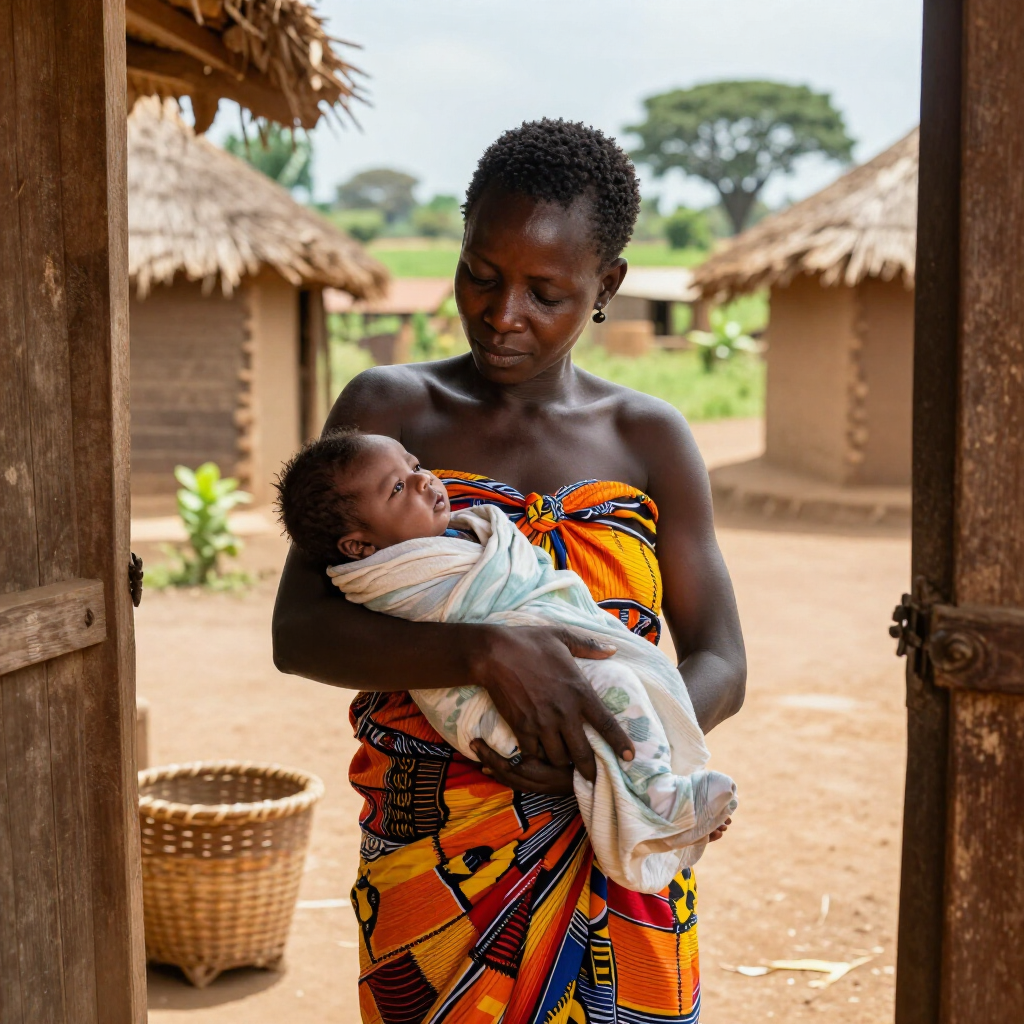
A mother walking into a clinic healthy should not leave in a coffin — and a newborn’s first month should not be its most dangerous. In Ghana, both still happen far too often, and the Bono Region carries one of the heaviest burdens in the country.
What the evidence says we can change
1.
Care continuity saves lives
Adequate antenatal, delivery, and postnatal care is associated with roughly a 75% reduction in neonatal death risk.
2.
The biggest killers are treatable
Hypertensive disorders and hemorrhage drive most audited maternal deaths — both are detectable and manageable with trained staff, basic supplies, and timely referral.
3.
Geography is destiny — unless we change it
Rural–urban gaps in access to skilled care concentrate deaths; the Bono Region’s feeder-road network and facility gaps compound risk.
4.
Skilled birth attendance and emergency obstetric capacity
At the district and community level.
5.
Reliable supply of essential maternal commodities
(e.g., for managing hemorrhage and hypertensive emergencies).
6.
Newborn-survival packages
Resuscitation, thermal care, infection prevention, breastfeeding support.
7.
Referral and transport solutions for rural catchments.
8.
Community data and surveillance
So deaths are counted, audited, and prevented.
The Data
| Indicator | Figure |
|---|---|
| Global malaria cases / deaths (2024) | ~282M cases / ~610,000 deaths |
| Africa region share of deaths | ~95% |
| Deaths among children under five | ~75% of deaths in the region |
| Ghana share of global cases | ~2.5% (top-15 burden country) |
| 2024 global malaria funding vs target | $3.9B — 42% of the $9.3B target |
| Proposed FY2026 U.S. PMI cut | ~45% ($805M → $424M request) |
Malaria
After two decades of hard-won progress, malaria is rising again — and the funding that drove the gains is being withdrawn. Ghana is a top-15 burden country and a former U.S. PMI focus country, leaving it directly exposed to the 2025–2026 financing shock.
Why this is a crisis now
The funding bridge is collapsing
The U.S. — historically ~37% of global malaria funding — dissolved USAID and proposed a ~45% PMI cut; Global Fund, Gavi, and European commitments have also fallen.
Commodities and surveillance are at risk
Delayed nets, diagnostics, and drugs push families toward informal markets and substandard medicines, while monitoring weakens exactly as drug and insecticide resistance spread.
The vaccine cost is shifting to countries
From 2026, malaria vaccine financing moves onto national budgets through Gavi’s new model — creating an immediate sub-national delivery and demand-generation gap.
Addressing urgent needs in malaria prevention and response through strategic support and innovative tools.
Identified needs (crisis-level)


This is the text area for this paragraph. Once you've added your content, you can customize its design by using different colors, fonts, font sizes and bullets.
[Placeholder]
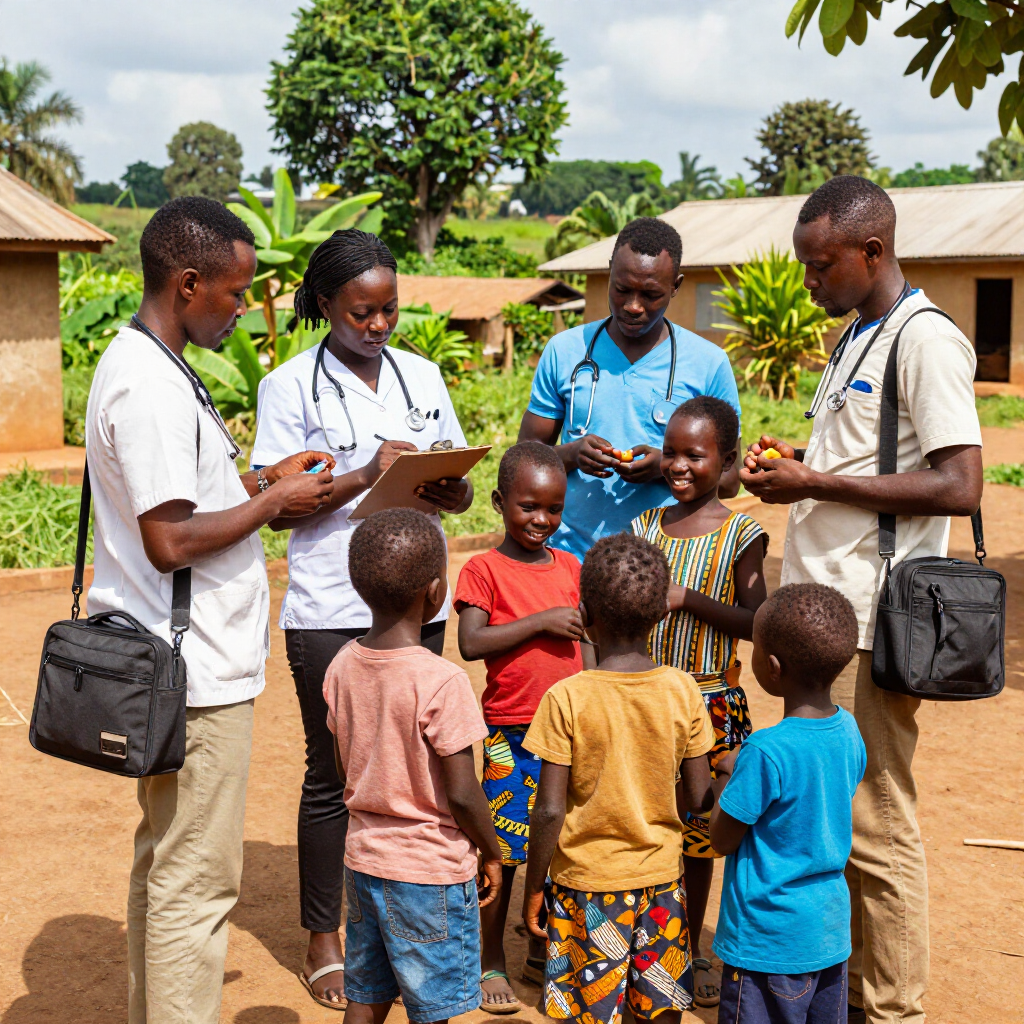
PGC’s interventions are built on evidence, not assumptions. We synthesize the best available national and peer-reviewed data, ground it in the realities of the Bono Region, and turn it into fundable, measurable pilots designed to launch — and prove results — quickly.
What we research

Burden & disparity mapping
Where mortality concentrates, and why — down to district and facility level.

Funding-gap analysis
How the 2025–2026 financing shock translates into specific commodity, staffing, and surveillance gaps on the ground.
[Placeholder]
Identity → Purpose → Execution → Coalition. We engage the diaspora and local stakeholders around a shared identity and purpose, convert that into a specific, measurable intervention, and build a coalition around one shared outcome — such as reducing child malaria mortality or maternal death in a defined pilot footprint.
How we work — the PGC method

Delivery models
Blended finance, diaspora capital, and public–private partnership structures with the governance and transparency funders require.